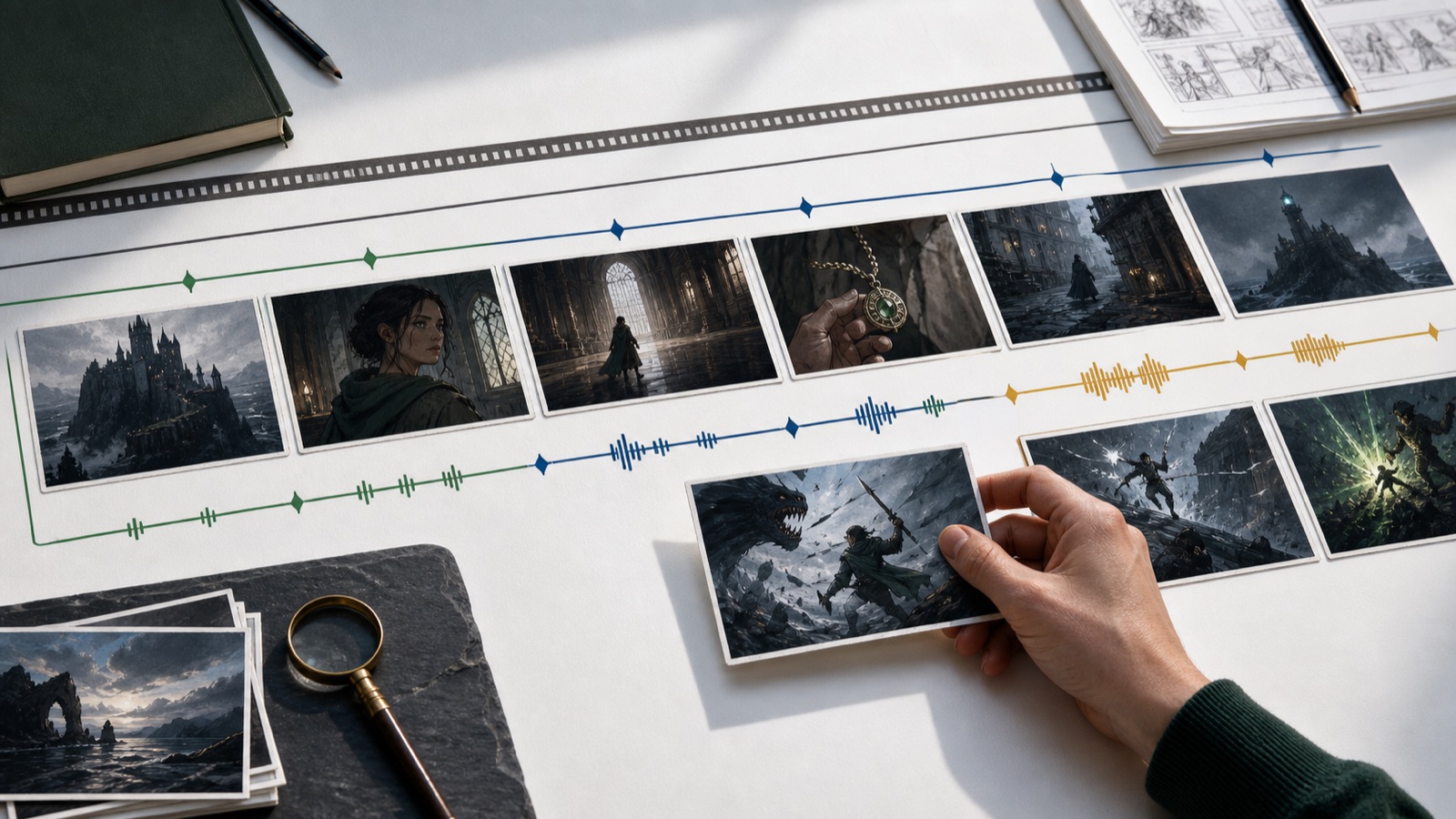
A script explains the story; a storyboard explains the screen
A script can tell us that someone hesitates at a doorway, but it does not decide what the audience sees first. A usable storyboard converts that sentence into visible decisions: an establishing frame for the room, a medium shot that shows the pause, a detail of the hand on the handle, and a reaction that lands the emotion. The goal is not to illustrate every sentence. It is to decide which visual changes deserve their own shot.
Without a shot plan, every later stage starts guessing
When the shot structure is missing, image generation has to guess composition, editing has to invent rhythm, and collaborators have to reinterpret intent. This is why a project can contain attractive frames yet still feel confusing. The images may be individually strong, but no shared plan explains what each frame contributes, how long it remains on screen, or what must carry into the next shot.
Pacing becomes measurable before editing
Short-form video has little room for unclear timing. A hook may need several quick shots, while a reveal needs enough time to be understood. By assigning a duration and purpose to every shot, you can see whether the opening takes too long, whether several explanatory shots appear in a row, or whether an emotional beat is cut before it lands. Fixing seconds in a plan is much cheaper than rebuilding finished media.
Continuity is a sequence problem, not a single-image problem
AI tools can produce a convincing frame without understanding what must remain unchanged across the sequence. A storyboard links each shot to reusable character, location, wardrobe, and prop rules. It also records screen direction and spatial relationships. That shared context gives later prompts a stable source of truth and makes inconsistencies easier to catch before they spread through an episode.
Every shot should have one primary job
Before choosing a lens or movement, write the reason a shot exists. It may establish a place, introduce a person, reveal evidence, show a reaction, advance an action, or close a beat. If two neighboring shots perform the same job, combine them. If one shot must perform four unrelated jobs, split it. This simple test keeps the sequence economical without making the story feel abrupt.
A lightweight storyboard is enough for most creators
A practical short-form storyboard only needs information that changes production decisions: shot number, visible action, dialogue or narration, duration, framing, movement, purpose, and continuity requirements. Add image and video prompts only after these fields agree. The storyboard is successful when you, a collaborator, or a generation model can execute the next step without reopening the original story to guess what was intended.
Review the plan before generating the frames
Read the titles as a sequence, scan the duration rail, and check that every change in location or emotional state is understandable. Confirm the recurring assets, then generate only the key frames that settle a real visual decision. This order lets you see the story at the lowest cost: structure first, selective images second, production handoff last.