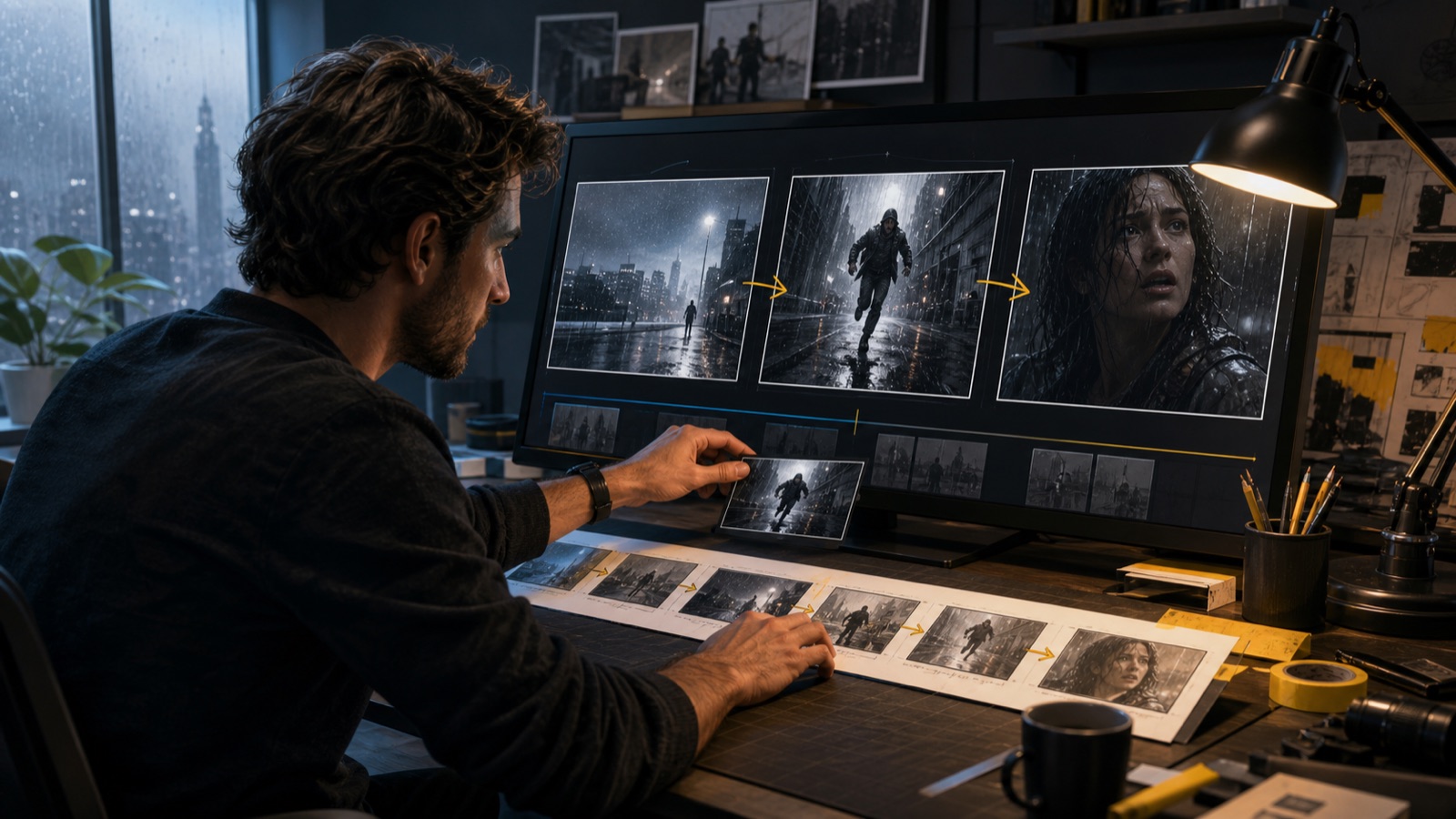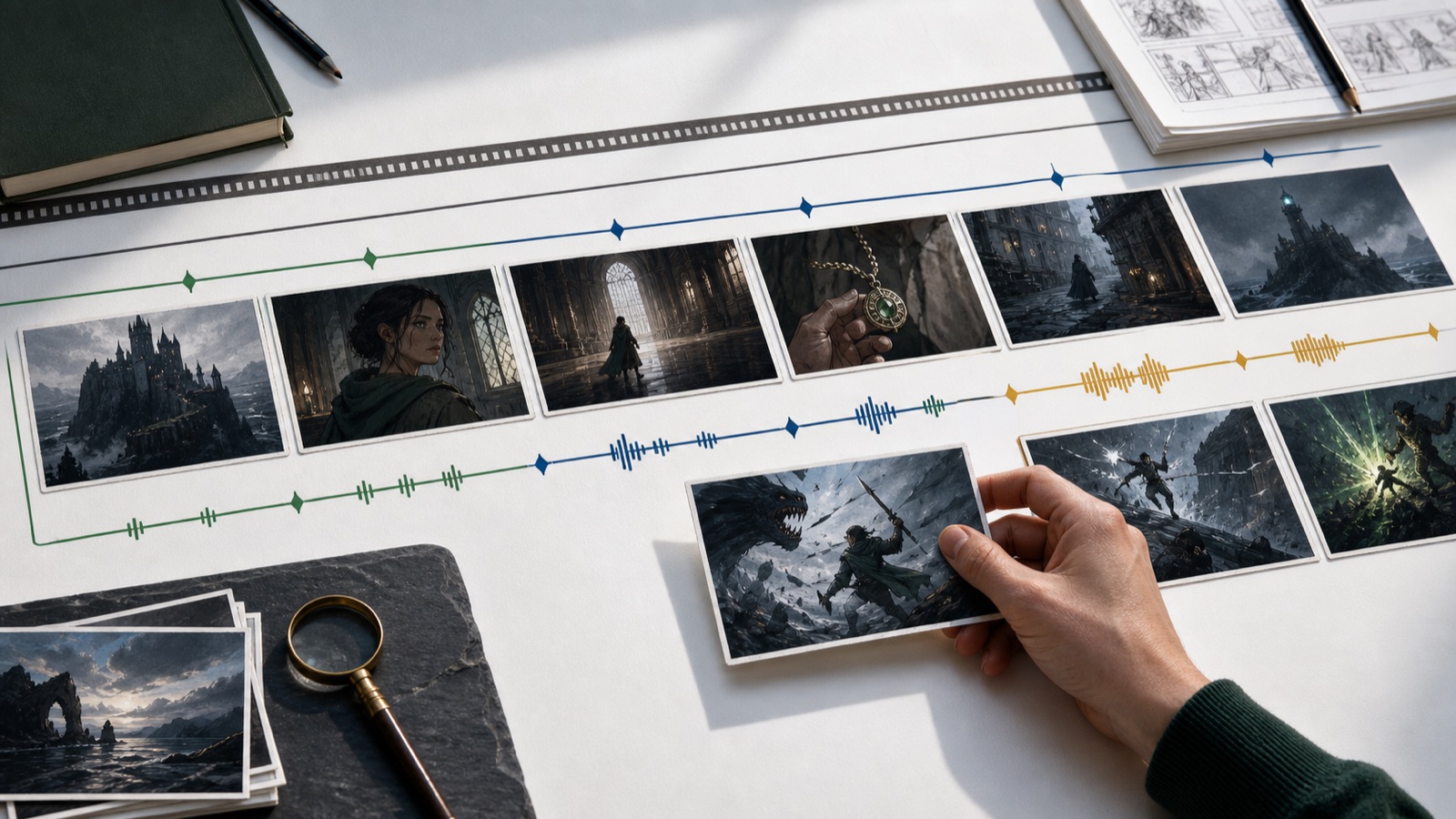
There is no universal shots-per-minute rule
Two passages with the same word count can demand very different sequences. A long internal monologue may need only a restrained performance and two or three visual changes. A short paragraph containing an entrance, a chase, a discovery, and a reversal may need many more. Word count measures prose length; shot count measures visible change and the time required to understand it.
Count visual events before counting shots
Mark each new location, character entrance, decisive action, reaction, information reveal, change of screen direction, and emotional turn. These are candidate shot boundaries, not automatic cuts. Group changes that can be read clearly in one composition, and separate changes that compete for attention. The resulting count is a much stronger first estimate than dividing the manuscript by a fixed number of words.
Use runtime as a hard budget
Estimate how long each candidate shot needs for its visible action, dialogue, and reading load. Add the durations and compare the total with the target runtime. If a 60-second episode contains twenty shots that each need five seconds, the problem is not editing speed; the plan is over budget. Shorten, combine, or remove lower-value beats before generating any media.
Different scene types need different densities
Action usually needs more shots because direction, cause, and consequence must remain legible. Dialogue needs enough coverage for relationship and reaction, but endless alternating close-ups quickly become mechanical. Emotional scenes may use fewer, longer shots, provided the performance changes inside the frame. Suspense often adds selective inserts and withheld information rather than simply cutting faster.
A useful planning range
For planning, a quiet single-location beat may begin around six to ten shots, a conventional scene with interaction and a turn may begin around ten to eighteen, and a dense action or multi-location sequence may exceed eighteen. Treat these as diagnostic ranges, never quotas. If every shot has a distinct purpose and the total duration fits, a count outside the range can still be correct.
Split when the audience must notice the process
Add a shot when the process carries meaning: a character notices danger, chooses whether to act, crosses an important distance, or reveals an object that changes the story. Do not add a shot merely because the prose contains another verb. Several simple actions can remain in one frame when their order is clear and none requires separate emphasis.
Compress repeated function, not essential meaning
When cost or runtime must come down, remove shots that repeat an established location, restate the same emotion, or show an action whose result is already obvious. Protect orientation, major decisions, reactions that change relationships, and information needed for the next beat. A lean sequence is not one with the fewest shots; it is one in which every remaining shot earns its time and generation cost.
Validate count on one continuity rail
Place the complete sequence on one rail and scan for clusters of identical duration, repeated framing, missing reactions, and abrupt location changes. Then read only the shot purpose column. If the story still progresses clearly, the count is probably close. If several purposes repeat, compress; if a major change appears without setup or consequence, add the missing bridge.