1. Subtitles are a storyboard decision
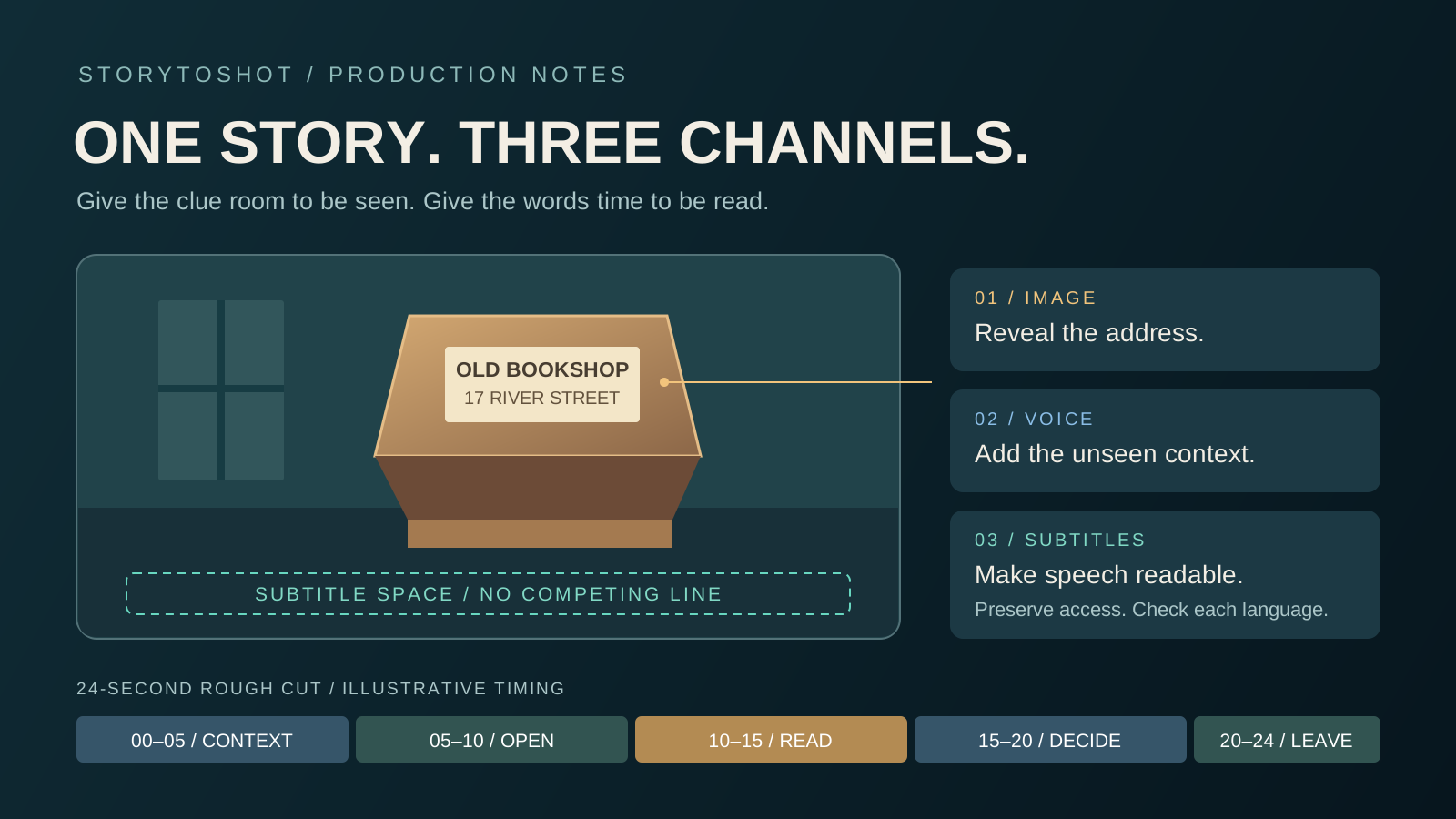
A girl opens an old box. The narrator says, “She opened the box,” and the subtitle repeats it, while viewers miss the address inside the lid. The problem is competing channels, not simply too many captions. Our fictional 24-second film follows Lan as she finds a box left by her mother before moving house, discovers an old bookshop address, and leaves with the box. Allocate information first, allow time to read it second, and generate shots third. Images convey visible action; narration supplies necessary context that cannot be seen; subtitles make speech readable. Repetition in accessibility captions serves a purpose, so do not remove meaningful speech merely for a cleaner frame. These timings are editing exercises, not platform specifications or universal reading standards.
2. Give each fact a primary channel
List four facts the audience must understand: Lan is moving; the box belonged to her mother; the address leads to an old bookshop; and she decides to go there. Assign a primary channel to each. Packing boxes and an emptied room establish the move; one narrated line identifies the owner; an insert reveals the address; leaving with the box shows the decision. Mark where another channel is needed, such as describing the address and departure for an audio-described version. Do not make a crucial clue depend solely on tiny, blurry lettering or use narration to rescue unreadable action. A four-column information sheet is enough: fact, primary channel, attention moment, and consequence of missing it. Missing the address breaks the ending’s motivation, so give it a clear view and dedicated reading time.
3. Expose attention conflicts in a 24-second rough cut
Build an adjustable timeline with still boards and temporary narration. Seconds 0–5: an emptied room and the box, with “Before moving, I found the box Mom left behind.” Seconds 5–10: she opens it, without narration. Seconds 10–15: the lid reads “Old Bookshop, 17 River Street,” with time to read. Seconds 15–20: Lan looks toward the door and picks up the box, with “This time, I want to go and see.” Seconds 20–24: she leaves, with footsteps and the door closing. The draft deliberately leaves space. Ask an unfamiliar viewer why she leaves. If they remember a nostalgic mood but cannot explain the address, change when the clue appears or how long it remains before adding more shots.
4. Reserve subtitle space in the composition
Overlay the intended subtitle box on each board, then mark faces, hands, props and story lettering. In the opening shot, hands and the clasp sit low in the frame; two subtitle lines could hide the cause and effect. Adjust the draft composition first: raise the box toward the middle or place narration before the action. If subtitles must move, make the change purposeful and check whether viewers can follow their position across cuts. A fixed percentage is not a universal safe area. Test the target aspect ratio, actual type size and playback interface together. Mobile controls, account labels or platform overlays may occupy part of the image; lock placement after confirming the delivery channel. Fitting text inside the frame does not mean viewers can read it while following the action.
5. Break by meaning and test reading time
Record temporary narration at a natural pace, then segment subtitles by meaning instead of squeezing speech into a predetermined slot. “Before moving, I found the box Mom left behind” can split after the opening phrase if the recording pauses there. Avoid separating a modifier from its noun across shots. Start with one or two lines and remove arbitrary breaks; this is a design starting point whose suitability depends on language, type size and device. If reading fails, shorten redundant narration, move a competing clue or extend the shot before shrinking the type. Record actual display intervals and align endings with sensible speech pauses. Do not automatically clear every subtitle at a cut, or carry an old sentence so far into new information that its reference becomes misleading.
6. Share meaning across languages, not rigid timings
The Chinese line “这次,我想去看看” and “This time, I want to go and see” convey similar intent without requiring identical reading or speaking durations. Keep a language sheet with shared shot IDs, information goals and key action moments, but separate text, narration and subtitle intervals. If English needs more space, remove words that do not change the intent or extend a reaction without critical action. Do not accelerate the whole performance and damage its mood. Recheck line breaks after translation, especially addresses, names and pronouns. Separate dubbed versions need their own synchronization. English subtitles over the original Chinese track should follow that track’s meaning intervals, rather than an imagined English voiceover timeline.
7. Review generated imagery and added text separately
The address inside the lid must be legible word for word. One production option is to generate a clean lid surface and composite the address afterward. This is a controllable workflow choice, not a claim about any model’s lettering ability. Specify lid orientation, visible area, hand occlusion and camera motion in the shot brief. A moving surface or changing perspective requires tracking, deformation and occlusion work; a flat overlay alone may fail. Review two things separately: whether the base footage preserves a usable surface, and whether the composite stays stable, readable and consistent with perspective. The address within the story and translation subtitles below it perform different jobs. Avoid presenting unrelated new information in both places at once.
8. Review in three passes and define accessibility scope
First, play normally without pausing and check whether the viewer connects discovering the address with leaving. Second, watch muted and verify that the subtitle version preserves the language needed to understand the story. If the delivery promises accessibility captions with sound information, include speaker identification and meaningful sounds, such as an off-screen knock, according to the agreed specification. A dialogue-only export does not establish that this is complete. Third, listen without looking to identify essential clues available only visually. This can reveal a need for audio description; ordinary narration does not automatically meet that need. Assign feedback to its channel: repair an illegible address in the image, reading pressure in text or duration, and unclear motivation in the storytelling. Change the main cause first so the result remains diagnosable.
9. Lock versions and state the method’s limits
Deliver a picture master without burned-in subtitles, the required subtitle files, a burned-in preview and the language version sheet, using the recipient’s requested formats. Include film or shot ID, language and version in filenames. Update subtitles when narration changes so a new track never ships with old text. Recheck the first and last captions, address hold and cuts in the exported file, not only inside the editor. This method suits narrative shorts with relatively little information. Interviews, instruction, rapid dialogue and distributors with strict caption specifications need tailored reading tests and delivery rules. Success means the target viewer can explain what the character discovered and why she acted after one normal viewing, without missing crucial action while reading.