1. First identify the problem behind the note
In a review, one person asks for a more cinematic look while another calls the pacing slow. The maker generates another batch, only to receive the same notes. The opinions never became observable goals. Consider a fictional fifteen-second watch-shop film: a customer brings in a stopped pocket watch; the owner recognizes its engraving and realizes it belonged to his father. Four shots establish the watch, recognition, reaction and acceptance. First translate feedback into the information it affects and the evidence that would count as a repair; only then decide whether generation is needed. Timings and version names below are working examples, not promises about software features. This method suits small teams reviewing an existing rough cut. If the story’s purpose is still undecided, return to the script first.
2. Lock the review version and collect observations
Share one review export, such as cut_v03, and define time as starting at the first frame of that export. Play it once at normal speed and ask reviewers to retell the story before discussing visual detail. Record “I could not read the engraving around seven seconds” as an observation; put “switch models” in a separate suggestion field rather than treating it as a proven cause. Retain the reviewer, shot ID, timeline interval and original wording. Add frame rate and timecode convention when precise frames matter. Do not confuse five seconds into a source clip with five seconds into the edit. Notes without a location belong under overall objectives until their scope is clear; otherwise people may repair different problems under the same label. Add a review goal to the export: this round checks whether the identity clue reads, while final grading remains open. A focused question reduces unrelated discussion, but still log any newly discovered mandatory defect.
3. Translate adjectives into acceptance statements
“The reaction is not moving enough” may concern acting, or viewers may simply lack a reason to care. Identify the misreading before writing an observable goal: before the owner looks up, viewers can connect the engraved name to the old photograph on the counter; his expression then shifts from professional courtesy to hesitation. A dislike of warm colors is a style preference. Support it with a reference and rationale rather than presenting it as a plot defect. Give each note one primary goal. Split “tighter, warmer and sadder” into separate items so that completing one can be recognized. Acceptance statements define an outcome; they do not promise that any particular prompt will produce it.
4. Prioritize story failures and the scope of their effects
Fix issues that block comprehension first, issues that weaken the effect second, and optional polish last. In this example, an incorrect engraved name breaks the identity clue and takes priority. A slightly brief reaction comes next. A different background lamp shape may not prevent the story from working. Consider scope as well: changing who owned the watch affects the engraving, photograph and performance, so resolve it early. Do not mark every note urgent or sort solely by ease of repair. Use must fix, worth testing and retain for this cut, each with a reason. Optional work can wait, but do not quietly downgrade a story failure merely to meet the deadline.
5. Choose the smallest effective repair before choosing a tool
The same note about an unreadable engraving can require different repairs. If readable frames already exist but the cut is too fast, extend the usable interval. If the lettering is wrong, consider a controlled post-production replacement or a new close-up. If the father’s name was never established, add the missing story information; sharpening cannot solve that. Inspect existing footage and editing handles before choosing an edit, post-production, a replacement shot or revised boards. Smallest effective scope means resolving the problem without unnecessary continuity work, not changing the fewest pixels. Extending the engraving at the expense of the essential reaction can still fail the film. Preserve the approved baseline before attempting any repair.
6. Write a repair ticket someone else can execute
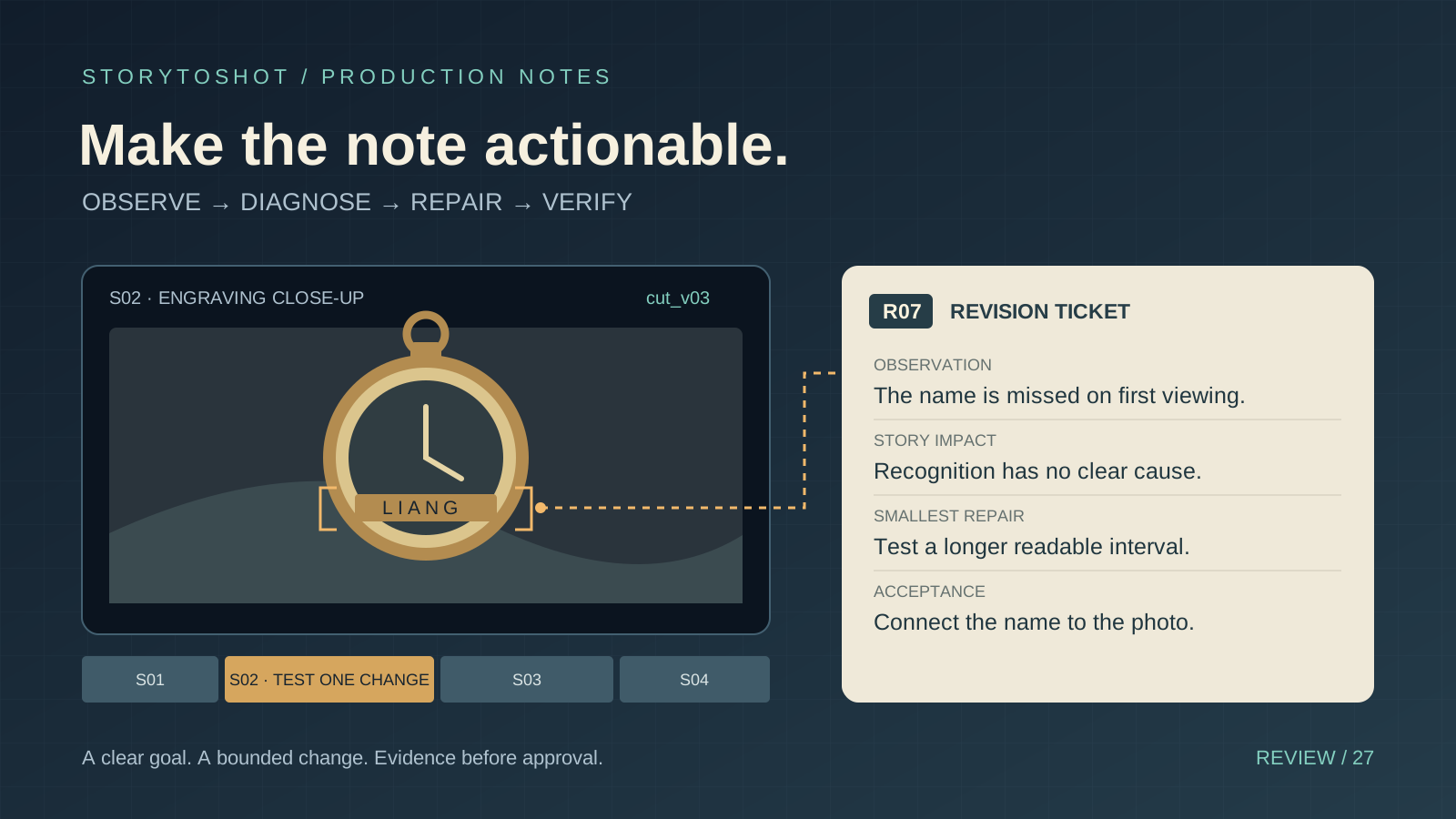
Reuse this ticket structure: “R07; baseline cut_v03; shot S02; roughly seconds 5–7 in the edit. Observation: the engraving cannot be read on first viewing. Impact: the owner’s recognition has no explanation. Change: first extend the existing clear close-up interval and recover time from an unnecessary opening hold. Preserve: watch design, holding hand, entry and exit directions, and the duration target. Acceptance: without pausing, an unfamiliar viewer can explain the connection between the engraving and photograph. Owner: editor. Status: awaiting trial edit.” If that trial fails, create a separate generation task with references. Log failed attempts too, so another collaborator does not repeat an ineffective approach. “Improve S02” is not an executable ticket. Before handoff, ask the person making the change to restate the goal. If they interpret it as enlarging letters when the actual goal is connecting two names, correct the ticket before spending production time.
7. Test one main hypothesis per revision
Create A and B: A retains the original edit, while B changes only the engraving’s readable duration, keeping grade, sound and performance stable. Ask “What do you think the owner recognized?” without identifying B as the improved version. Changing music, color, face and captions together makes the reason for any improvement unclear. This comparison informs a production decision; it is not a statistical experiment or proof of universal comprehension. If B still fails, revisit the diagnosis. The lettering may be clear enough while the photograph arrives too late. Reordering information would then be more useful than extending the close-up again. Record the hypothesis, changed element, observation and next step for every trial.
8. Resolve conflicting notes and check downstream changes
“Make it faster” and “hold the engraving longer” can coexist: shorten a redundant opening action while protecting the clue. But if duration and every piece of information are fixed, someone must make an explicit tradeoff. Do not send contradictory requirements into generation. Assign one decision maker to resolve notes against the agreed story goal and retain reasons for rejected suggestions. After replacing S02, watch S01, S02 and S03 together. Does the holding direction match? Does the emotion arrive prematurely? Does the sound still coincide with the lid opening? Check the full cut after local approval, especially neighboring shots, captions and sound. Correct lettering does not close a ticket if the repair breaks the action across cuts.
9. Close notes with evidence and scope new requests separately
Close a note with evidence such as “S02 replaced in cut_v04; passed at normal playback speed; neighboring shots and sound checked,” linked to the actual review export. A green status alone is insufficient. Have the original reviewer or designated approver confirm against the same acceptance statement; record any remaining disagreement precisely. A new style direction after approval is a new request. Describe its effects on approved shots and delivery timing instead of treating it as an unfixed old defect. Stop when necessary information works, mandatory issues are closed and accepted limitations are documented, not when nobody can imagine another improvement. Solo creators can use a simple table. High-stakes commercial delivery still requires separate brand, rights and technical specification checks.