1. Treat the new frame as a new information layout
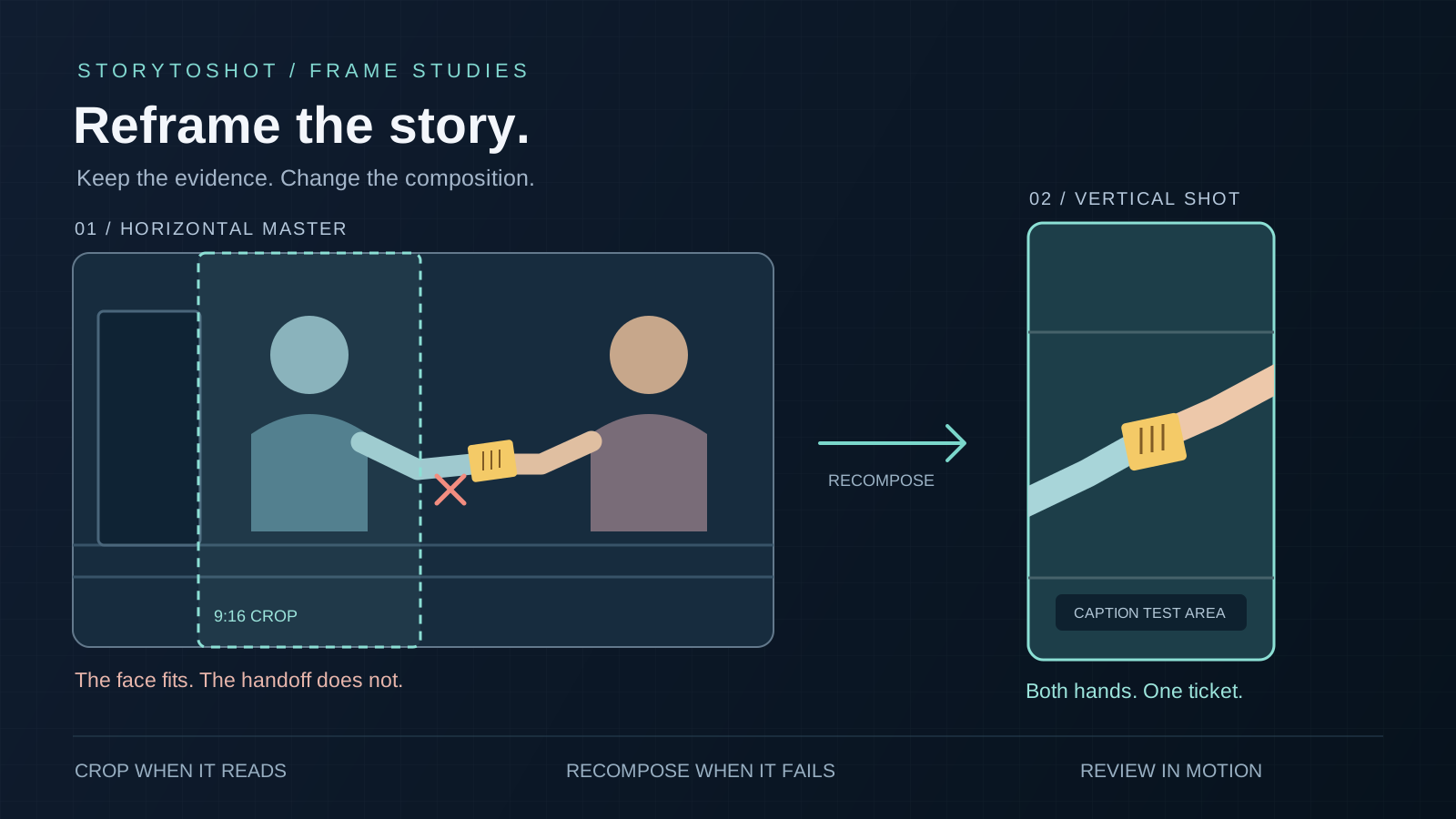
A horizontal frame may show two people, a hand and a door, while its vertical crop shows only a face. That is missing story evidence, not simply insufficient resolution. Use this fictional 18-second exercise: on a station platform, a sister is leaving. Her brother reaches in from screen right with the ticket she forgot; she accepts it, then walks toward the train door on screen left. Viewers must understand who offers the ticket, whether she receives it and where she goes. Preserve each shot’s viewing task while allowing composition and shot count to change. Write those three questions before drawing both versions. Do not begin by applying one vertical crop to the finished film. This exercise concerns composition; it does not promise lossless AI expansion or permanent interface margins for any platform.
2. Calculate the window before judging the crop
Assume a 1920 × 1080 source and a 9:16 target, keeping the source’s full height without bars. The retained source width is about 608 pixels, roughly 32 percent of the original width. This is geometry, not a quality guarantee. Scaling that region to 1080 × 1920 does not automatically restore lost detail. Draw this narrow window over the opening frame, the contact frame and the ending frame, then inspect the entire movement path. Fitting a face does not mean the offering hand, ticket and recipient fit together. If the crop must keep shifting horizontally between people, record each move and its purpose. Decide whether that movement deliberately guides attention or merely creates an oscillation introduced by the crop.
3. Mark essential evidence, optional context and overlays
Use three marks on each storyboard: solid outlines for essential evidence, dashed outlines for optional context and hatching for possible caption or interface coverage. In the handoff shot, outline both hands, the whole ticket and their contact space, not only faces. The door can be absent here, but the departure shot must restore the exit. When placing temporary captions near the bottom, check whether they cover hands or the ticket, rather than merely staying inside the frame. Derive protected areas from a preview of the actual delivery interface. If the destination is undecided, keep captions adjustable and flag them for another review. A fixed percentage margin cannot guarantee visibility across devices, players and interface controls. A clean editing preview does not prove the published viewing area will be equally clear.
4. Establish a four-shot horizontal baseline
Start with four horizontal shots. S01, zero to four seconds: a medium two-shot puts the sister left, brother right and door behind her on the left. S02, four to nine seconds: a close handoff shows his hand entering from the right and hers receiving from the left. S03, nine to twelve seconds: she holds the ticket near her chest and looks toward the door. S04, twelve to eighteen seconds: a wider shot shows her leaving left while he remains. Adjust these rehearsal timings for readability. Give each shot one acceptance sentence: S02 must show the ticket moving from his hand to hers, rather than merely looking polished. This baseline lets both formats be judged against the same story outcome. Establish it first, or an existing causal gap may be misdiagnosed as an aspect-ratio problem.
5. Choose cropping, recomposition or a split for each shot
Decide shot by shot. Crop S03 if the face, ticket and looking direction have breathing room. If S02’s hands are too far apart, design a tighter handoff close-up that preserves right-to-left transfer; enlarging one hand cannot make an unseen exchange complete. If S01’s side-by-side staging will not fit, try a vertical two-shot with depth while keeping the brother and door recognizable. If S04 cannot show both departure and the brother staying, split it into her move toward the doorway and his watching shot, redistributing the six seconds. Add a shot only for necessary information, not an automatic reaction face. Expanding the canvas adds space; it cannot establish a previously unseen hand action. Any generated area still needs checks for people, door geometry and lighting.
6. Keep shared story IDs and separate composition records
Keep a shared story ID with format suffixes such as S02-H and S02-V. For a split, use S04-Va and S04-Vb, recording that together they perform S04’s departure task. A reusable vertical brief is: “Purpose: make the ticket handoff readable. Composition: vertical close-up of hands, ticket centered, both hands visible throughout. Action: right hand offers; left hand secures the ticket before right hand releases. End: ticket stays in the left hand. Preserve: platform background and light direction. Exclude: a second ticket.” Add references, start and end states, caption clearance and version number. Approve vertical stills before generating motion, but do not treat still approval as proof of a successful intermediate exchange. Use format settings actually supported by the tool, then verify both the output dimensions and the visible composition.
7. Review the moving vertical sequence, not just thumbnails
Side-by-side thumbnails help inspect appearance, but continuous playback reveals a disappearing ticket, sudden crop acceleration or a departure that switches screen direction between cuts. Watch once without sound, inspect contact and release frame by frame, then restore sound to judge timing. For an animated crop, check whether its movement anticipates the essential action, reveals blank edges or turns a locked shot into an unmotivated pan. A direction change can be intentional, but spatial information must make it understandable; calling vertical framing tighter is not an explanation. Repair the identified fault: recompose when the window cannot retain the hands, move captions when they hide the ticket, and replace footage or add coverage when the exchange itself is missing. Repeated sharpening cannot supply absent narrative evidence.
8. Test the story at its actual viewing size
Play both versions on the intended screen or player at normal viewing size without explaining the plot. Ask someone unfamiliar with the boards who gave what, whether the transfer finished and who eventually left. Record their own account before asking where visibility failed. For this exercise, all three answers must be recoverable from the pictures. One viewer is a useful diagnostic, not statistical proof of universal clarity. If the vertical version implies the sister always had the ticket, revisit the source of the action in S02. If her destination is unclear, revisit the exit and ending. Test with and without captions so text does not silently repair missing visual storytelling. A tiny ticket on a phone may need more space in the composition or a longer hold, rather than merely a higher-resolution export.
9. Deliver two verified versions with explicit limits
List dimensions, frame rate, duration, audio version, caption status and shot IDs separately for both deliverables. Mark reused, recomposed and split shots. Check the actual exported files, not only project settings. If a scene depends on horizontal distance, such as people confronting one another across a long table, vertical restaging may change the relationship. Consider retaining the full horizontal image with designed space above and below, or making a separate vertical adaptation instead of forcing a full-frame crop. Choose according to the viewing situation and delivery requirements. On the next project, sketch essential shots in both formats while adapting the script and budget extra generation only for incompatible shots. The goal is not identical frames; it is enough visible evidence for viewers to reach the same story judgment.