Judge comprehension before beauty
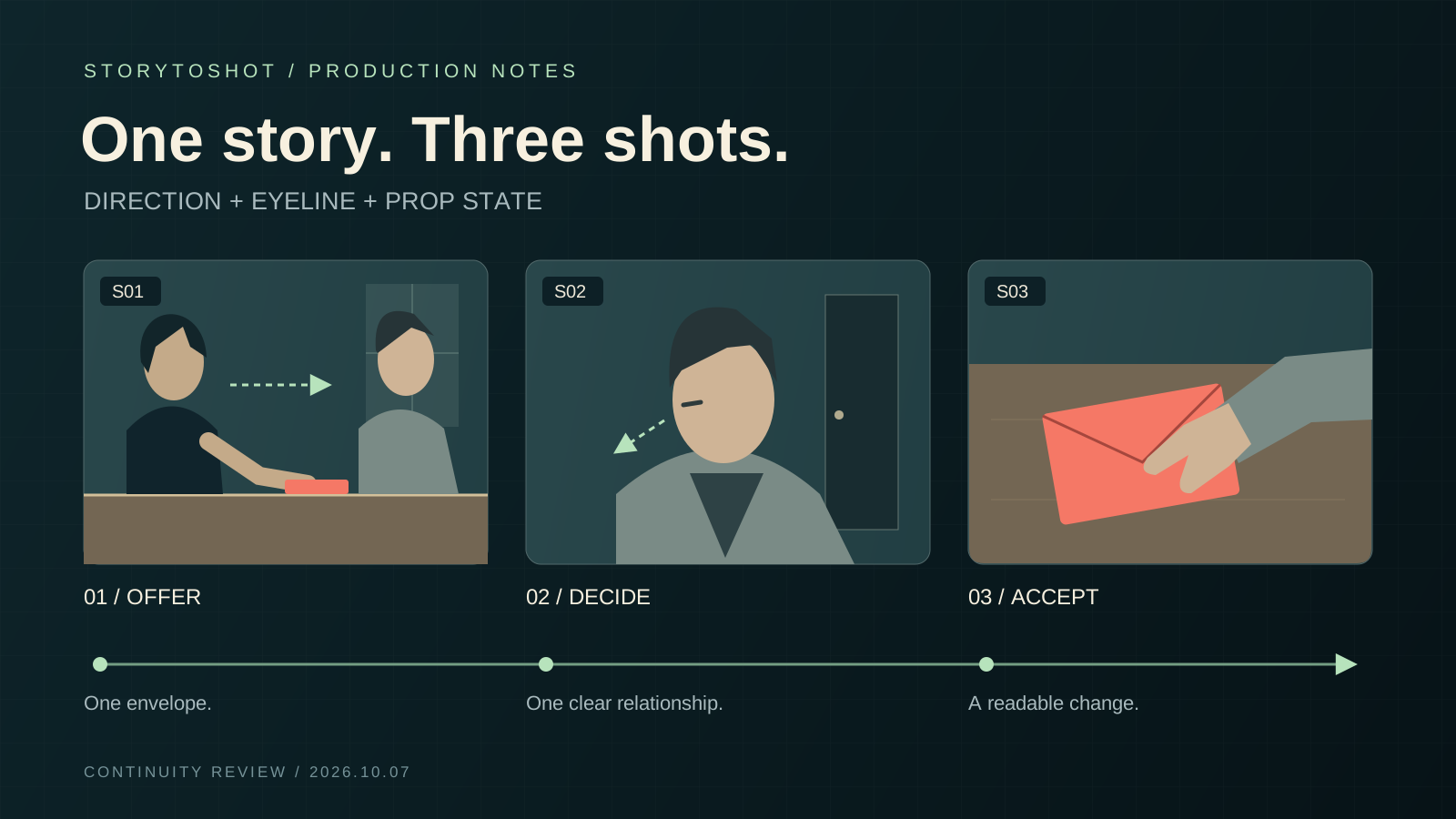
Three clips can look beautiful on their own: a woman offers an envelope, a man looks down, and he puts it in his pocket. Yet the edit can feel like two unrelated people doing separate things. The problem is often the relationship lost between shots, rather than image sharpness. Continuity review should establish who is where, who acts on whom, and what changes. This guide uses a roughly twelve-second café handoff as a working example; that duration is an exercise choice, not an industry standard. Write one acceptance sentence first: “The viewer understands that the woman gives the only red envelope to the man, who hesitates before accepting it.” Color, composition and motion should support that event. Even a striking clip is unsuitable if it makes the recipient or outcome unclear.
Fix the space and axis with an overhead sketch
Draw a table from above: the woman sits to the west, the man to the east, the window is north, and a door is behind the man. The line between the two people is the reference axis for this exchange. Put the three planned camera positions south of that line, then sketch thumbnails: the woman generally looks toward screen right and the man toward screen left. These directions describe the viewer’s image, not the performers’ own left and right hands. The window and door become spatial anchors when reviewing reverse angles. The 180-degree rule is a common way to preserve readable space, not a ban on crossing the line. If the story needs a reversal, show the camera crossing continuously or use a clear wide shot to re-establish positions. Writing “preserve the axis” in a prompt does not specify the actual composition.
Write an entry and exit state for each shot
Give the sequence three distinct jobs. S01, a roughly four-second two-shot: the envelope starts in the woman’s right hand; she slides it to the center of the table, and the man has not touched it yet. S02, a roughly three-second close-up of the man: he looks at her, then down at the table, and starts reaching with his right hand; he has not picked it up by the end. S03, a roughly five-second hand insert: the envelope is still at the table’s center; his right hand contacts it, picks it up and puts it in his inner coat pocket. Record entry state, visible action and exit state on every card. This reveals errors such as the man already holding the envelope and then picking it up again. The example places the handoff cut around contact. If you cut during the reach, also match its progress instead of joining complete generated clips mechanically.
Separate fixed conditions from the current action
Keep only continuity-critical facts in the shared brief: the woman’s dark cuff, the man’s gray coat, a plain red envelope, fixed seating and a consistent window-light direction. Describe the current action and framing separately. For S02: “Close-up of the man, looking toward screen left at the woman opposite him, then down toward the tabletop below frame. His right shoulder moves slightly forward as his right hand starts reaching out of frame. He has not picked up the envelope. Keep the camera on the established side of the axis.” This is an inspectable shot brief, not a guarantee that a particular model will obey it. If the reference image puts the door in the wrong place, correct the reference first; adding contradictory text is not a reliable fix. Avoid asking for a locked camera, an orbit and a fast push-in simultaneously, since that makes the intended result difficult to assess.
First pass: watch direction and eyelines in sequence
Assemble candidate clips into a rough cut and watch them silently at normal speed, setting aside color and finger details. Does the woman’s envelope movement lead toward the man? Do the reverse-angle eyelines answer each other? Does his downward look plausibly lead to the tabletop shown next? Both people looking screen right is a reason to investigate in this simple, fixed-seating exchange, but it is not a universal error across all compositions. Pause at each cut and compare the last usable frame of the outgoing shot with the first usable frame of the incoming one. If space remains unclear, return to the overhead sketch rather than guessing seating from a close-up. Normal-speed playback reveals disorientation; paused comparisons help locate its cause. Either method alone can miss problems.
Second pass: check props, hands and action progress
Track the envelope through the entire sequence: is there always exactly one, do its color and flap orientation remain plausible, does its tabletop position make sense, and does the same hand pick it up? Checking only first and last frames is insufficient: the envelope might briefly duplicate or return to the table after being lifted. Step through the short intervals around contact, occlusion and frame exits, then replay at normal speed to judge the effect on comprehension. Log a time reference for each issue, for example “S03 00:01.20: envelope splits at contact, violating the single-prop requirement.” This is an illustrative notation; use your editor’s actual timecode. A slight hair change can be assessed against the intended delivery. A duplicated story-critical prop changes the event itself and cannot be excused by an attractive image.
Classify takes as keep, edit or regenerate
Do not leave notes such as “odd” or “not realistic enough.” Keep a take when space and the action’s outcome are clear and minor defects are acceptable for the intended use. Edit it when, for example, an error occurs only at the end and an earlier cut preserves the necessary information, or an existing, appropriate reaction shot can cover the faulty interval. Regenerate when the recipient is wrong, a critical prop appears or disappears, or causality is lost and available footage cannot restore it. Try inexpensive repairs first, but removing a defect is not the same as explaining the event. Cutting out the entire pickup and jumping to the man leaving may obscure whether he accepted the envelope. A replacement hand insert must still match seating, cuffs, prop position and light; otherwise it relocates the continuity break.
Change one decision per repair and set a retry limit
If S02 has the wrong eyeline but an acceptable face, costume and pace, revise the eyeline and corresponding composition first while keeping the other references, and record a version number. Changing character references, camera movement and lighting together makes improvement harder to explain. Set a production constraint for each issue, such as allowing two retries with explicit hypotheses before reconsidering the shot. That is a project management choice, not a promised success rate. If both fail, consider a simpler camera position, a two-shot, or removing the shot without losing information. Do not spend the whole sequence’s budget rescuing a complex close-up. Horizontal flipping is not a general solution either: it also reverses writing, handedness, costume details and lighting, all of which need checking.
Lock approved versions in a handoff record
Use a handoff record with these fields: “Shot | Take version | Entry state | Exit state | Direction and eyeline | Prop check | Decision | Issue timecode | Owner.” Example: “S03 | v03 | Envelope at table center | Man puts it in inner pocket | Right hand continues previous shot | One envelope, no duplication | Keep | None | Editor.” Once versions are locked, play the sequence with sound and ask someone who has not read the script to describe the event in one sentence. If they say the woman takes the envelope back, revisit the cuts. Sound can connect emotion, but it should not conceal a missing essential action. This method suits narrative scenes that need clear spatial causality. Dreams, subjective montage and deliberate disorientation may depart from it, provided the intention is recorded. In StoryToShot, establish actions, assets and shot order first, then feed review decisions back into the storyboard so the next generation has a concrete purpose.