1. Start with the audience’s question
A suspense scene can fail when a frightened character knows less than viewers who have already seen a visitor carrying a lost-property bag. It can also fail when the key object remains unreadable until a caption explains the ending. Use this fictional twenty-second exercise. Lin hears a faint sound outside, sees a visitor through the peephole and eventually discovers that the visitor is a neighbor returning a key. The audience’s question is why this person has come. Treat every shot as an allocation of information. Specify what viewers know, what Lin knows and what the next shot adds. Suspense needs an uncertainty grounded in visible evidence, with clues becoming readable over time. Define the question the ending must resolve before deciding what to withhold. The duration is a working example that can change with performance and reading speed.
2. Build a three-column knowledge table
At each story beat, fill three columns with what the audience knows, what Lin knows and what remains unrevealed. Initially both hear a sound outside. After the peephole shot, both know someone is there but neither knows the purpose. The key close-up finally explains the visit to both. Showing viewers the key before Lin opens the door changes the dramatic question to when Lin will stop misunderstanding the situation. Either structure can work, but choose before storyboarding. For every entry, identify the frame or sound that supplies the knowledge. Move unsupported assumptions back into the unrevealed column. The writer’s knowledge that the visitor is a neighbor does not mean a first-time viewer recognizes that face.
3. Allocate five information beats
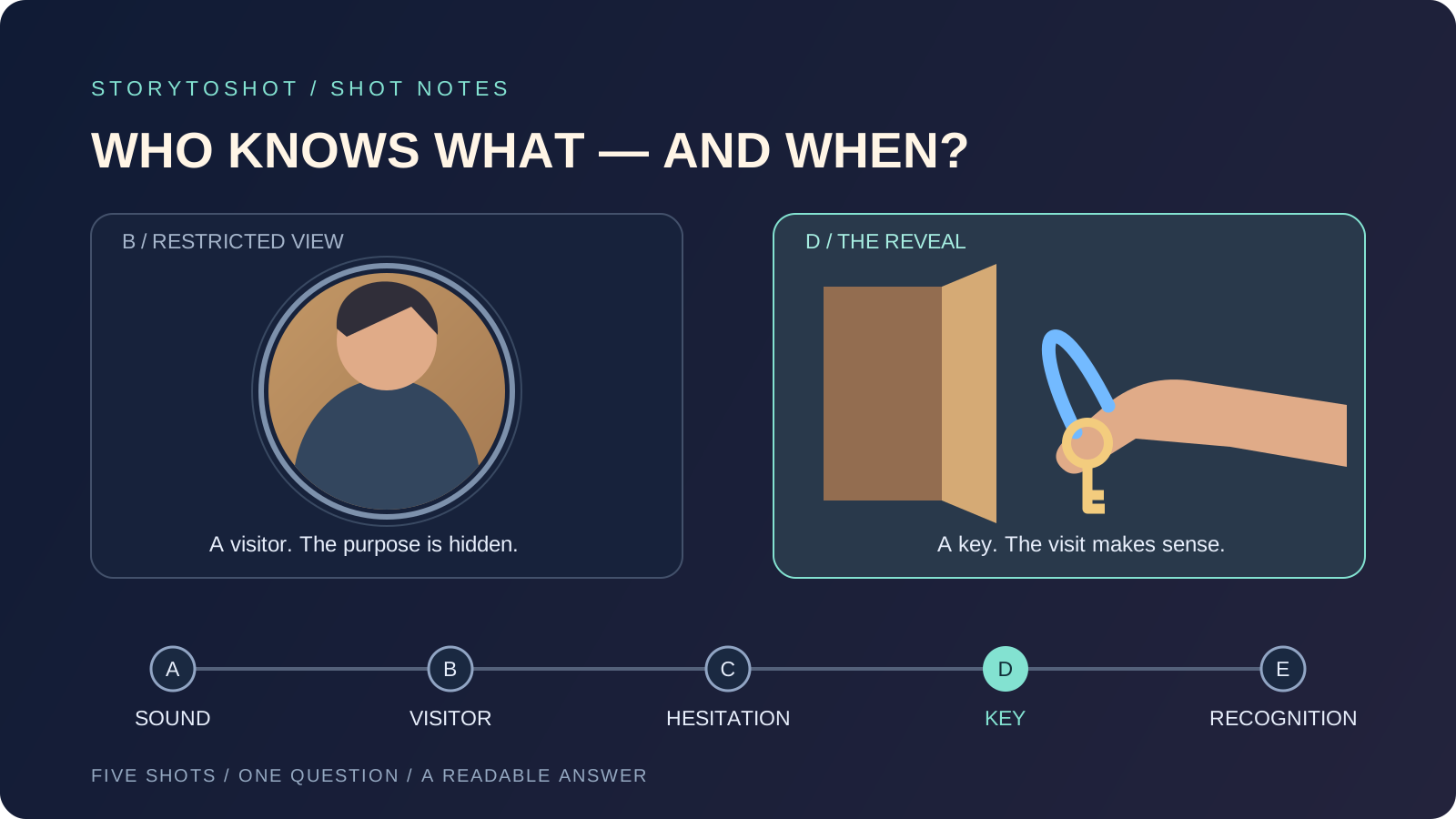
Start with five storyboard frames. A, seconds zero to four, is an interior medium shot as Lin stops working and turns toward the door after a faint sound. B, four to eight, is a peephole view of the visitor waiting with head lowered and hands outside the frame. C, eight to eleven, shows Lin looking toward the handle, hesitating and reaching. D, eleven to sixteen, shows the door opening slightly and the visitor raising a key on a blue lanyard, revealing the purpose. E, sixteen to twenty, is a medium two-shot as Lin accepts the key and relaxes. These are provisional timings. If D does not allow recognition, borrow time from the hesitation. Give each shot a new piece of information a viewer can describe. Three successive frightened expressions may only repeat the same beat.
4. Make subjective views traceable
Make the peephole image legible as Lin’s view. Establish Lin approaching the door, cut to the restricted view outside, then return to the reaction. Framing and eyelines should agree, including where the visitor stands and where Lin subsequently looks. A sudden overhead hallway angle may suggest an independent observer and information unavailable to Lin. A subjective image can be stylized, but styling cannot establish the viewpoint by itself. Cut still frames together and ask a test viewer whose view the shot represents. If answers diverge, clarify the looking action or change the camera position before generating detailed footage. The whole sequence does not need subjective coverage. External reaction shots can show how Lin interprets the available evidence.
5. Specify when the key object becomes visible
Write observable constraints into each generation brief. For B, describe an interior peephole view of the hallway, the visitor’s upper body centered, both hands below frame, a locked camera and quiet waiting. For D, describe a view from Lin’s side of the door as the gap opens and the visitor raises a key on a blue lanyard into a readable position, holding it briefly. Splitting the tasks avoids asking one generated clip to conceal an object, turn, open a door and deliver the reveal. Check reference frames too, including mirrors, glass reflections, pocket openings and frame edges. An early glimpse of the blue lanyard can change the clue. Confirm which references and constraints the chosen interface supports, then judge the actual output.
6. Apply the same information rules to sound
Concealing the key visually may accomplish little if a clear metallic jingle identifies it early. Decide whether the opening cue is a light tap, stopping footsteps or moving keys, and enter it in the knowledge table. This exercise uses a faint tap to raise the question of someone outside, reserving the key sound for the raised hand in D. Sound can deliberately offer an early clue, provided you know which knowledge column it changes. Review music separately. Strong horror scoring may present an ordinary neighbor as a definite threat and make the ending feel manipulative. Test the silent edit and then the sound track alone, recording what each permits viewers to infer. Finally check whether the combined version reveals the answer prematurely or sends conflicting signals.
7. Separate curiosity from confusion with a first-view test
Ask someone who has not read the script to watch the complete draft without live explanation. Afterwards ask what answer they were waiting for, when they understood the visit and whose key it was. Then revisit the sequence against the table. Unclear fear may indicate that the opening lacks a reason for Lin’s response. Recognition in B calls for a check of frame edges and sound. Continued uncertainty after D calls for a more readable object or clearer return gesture. A small number of viewers can help locate ambiguity but cannot establish population-level effectiveness. Record the shot and evidence behind a reaction rather than merely saying that suspense is weak. Repeat viewers already know the answer and cannot substitute for a first-view test.
8. Repair the specific information gap
When a reveal fails, distinguish an unseen detail, an unclear meaning and an implausible explanation. If the key is hard to see, adjust D’s framing, contrast or hold. If viewers see it but miss the return, clarify the handoff in E and Lin’s recognition. If the misunderstanding seems implausible, check whether earlier shots provided overly definite evidence of hostile intent. Adding explanatory captions across the film also changes disclosure timing. Alter one information condition per revision and compare versions in the same order. Keep the version, affected shot, intended understanding and review result together. A changed action start in D also requires checking Lin’s eyeline in C and the handoff into E.
9. Carry the knowledge table into production
In StoryToShot shot descriptions, include the viewpoint owner, new audience information, object visibility timing, sound clues and acceptance condition. Pass the same table to generation and editing. For this exercise, a first-time viewer should understand that a visitor is outside, identify the key at the reveal and recognize that Lin has recovered a lost possession. A comedy where viewers know the answer first needs a different knowledge order and different review questions. This method suits suspense, misunderstandings and discovery scenes, and can help examine the reveal order in product demonstrations. Teaching, operating instructions and urgent notices need timely clarity as a priority. At every cut, check whether viewers have moved closer to an answer while still understanding why they want to keep watching.