1. An action can happen without being understood
A busy clip shows a hand rising, a machine light flashing and a box stopping, yet viewers cannot say who prevented the accident. The action may have been generated successfully while its causal evidence remained invisible. This fictional twelve-second exercise follows Ning noticing a box approaching the end of a conveyor, pressing a red stop button and leaving the box safely short of the edge as the belt stops. Design the evidence the audience must see before choosing action, camera position and cuts. This is a storytelling exercise, not safety guidance for real machinery. Twelve seconds is a rough-cut starting point, not a generation-platform requirement. An unfamiliar viewer should understand, in one viewing, that pressing the button prevented the box from falling.
2. Rewrite the plot as three visible facts
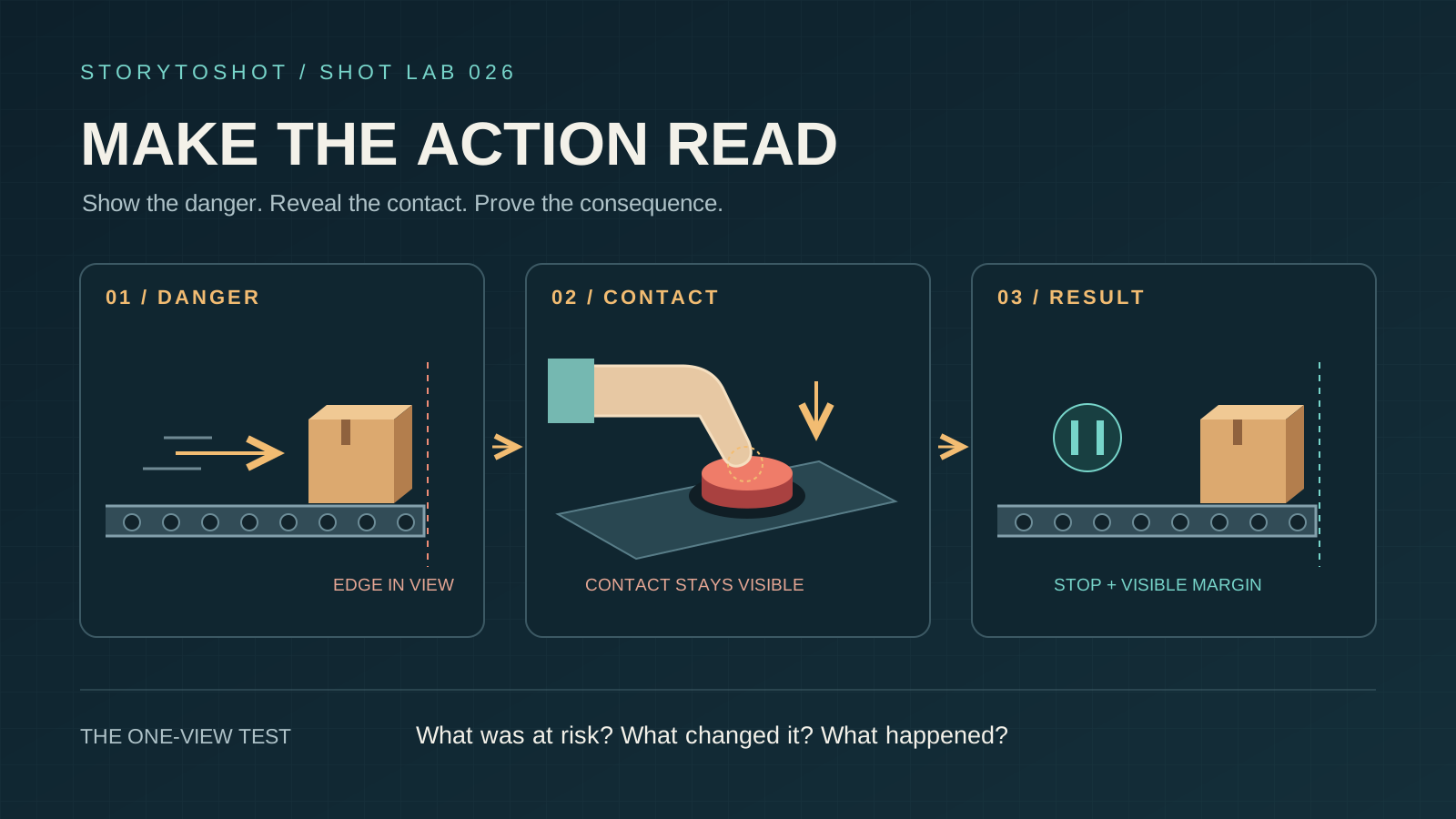
Write a chain that works without dialogue: danger approaches, Ning intervenes, and that intervention stops the danger. Each fact needs an observable change. The box moves relative to the edge; a finger contacts and depresses the button; then both belt and box stop while the edge remains visible. A surprised face does not establish danger. A hand reaching toward a button does not establish a press. An isolated still box could belong to another moment. Record the likely misreading beside each missing fact: no reason for urgency, no clear intervention, or no evidence of success. Repair that gap before increasing the shot count.
3. Test the viewing order with three boards
Sketch three rough boards without polishing their finish. The first contains the box, its travel direction and the edge. The second gives the finger and red button distinct outlines. The third returns to a recognizable edge position and shows the remaining gap. Show these in order to someone who has not read the script and ask what happened, without calling it a rescue first. If they think Ning merely switched on a light, establish the control panel’s relationship to the conveyor in the first board instead of explaining it with a final caption. Still boards test composition and information order; they cannot prove that moving action reads clearly. A timed rough cut comes next.
4. Protect the decisive contact from occlusion
The button shot must communicate a press, not merely an attractive hand. Choose an oblique side view that reveals the fingertip, the button’s top and its downward travel. Keep the palm from fully hiding contact, and separate the red button from similar background lights. Reduce the image to a phone-sized preview and check whether the action remains legible. If it only works enlarged and paused, change framing, angle or local contrast. Centering is not mandatory: an off-center button works if attention reaches it in time. Occlusion is a choice. Parts of the reach may be hidden, but the contact and depression carrying the story turn need sufficient visible evidence.
5. Give the decisive moment one dominant change
A circling camera, turning head, changing warning light and tumbling box can compete with the button press. For the first version, hold the camera still and give the hand one clear press. Place the reaction afterward and remove decorative light changes where possible. Complex motion is not forbidden; establish a readable baseline first. Rank the changes: button depression is mandatory, the hand’s approach is supporting information, and a relieved expression can wait. If camera motion remains, check that it reveals contact instead of moving it out of view at the critical instant. Rewatch at normal speed after adding any change. Attractive boards alone cannot approve moving action.
6. Time preparation, contact and consequence in a rough cut
Try seconds 0–4 for the box approaching the edge and Ning noticing; 4–7 for the hand approaching, contacting and depressing the button; and 7–12 for the belt slowing to a stop and the box’s final position. These are trial allocations, not mechanical cues. Give viewers time to find the button before contact and retain evidence after depression instead of cutting on the first touch. Beginning the consequence shot with motion generally communicates change more clearly than suddenly showing a stationary box. If deceleration needs longer, extend that section or shorten the reaction rather than teleporting the box into safety. Test with simple animation or temporary footage before investing in full generation.
7. Put readability requirements into the shot brief
A usable brief might read: “Locked oblique close-up. The red button sits frame right. Ning’s right hand enters from the left. The fingertip pauses above it, then contacts and depresses it. Keep contact visible and hold briefly after the press. Only this operating hand appears; the control-panel background stays stable.” Attach a reference and acceptance items: clear target, visible contact, definite depression and no distracting action. Stating intent does not guarantee model execution. If a tool lacks a particular input type, retain the written brief and record what input was actually used. Avoid packing the whole rescue, elaborate camera work and emotional performance into one prompt. Generate by shot if useful, while retaining button design, costume and spatial relationships.
8. Separate broken action from unclear presentation
Watch once at normal speed, then locate the fault frame by frame. A finger passing through the button or a button that never descends is a failure of the action itself; repair or regenerate that shot. Correct action hidden by the palm is a presentation failure; try another angle or framing. If both are clear but the cut arrives before viewers notice, adjust the edit first. A click sound should reinforce an established visual relationship, not substitute for missing visual proof. Log the fault’s time, the missing evidence and the smallest useful change. Recheck continuity after changing the camera, but a failed press does not automatically require regenerating the entire film.
9. Approve through unaided retelling and respect the limits
Play the finished export once on the intended device for someone unfamiliar with the script. Ask three open questions: what was the danger, what did the character do, and what happened afterward? Record their own words before choosing a repair. Avoid leading them with “Did you see her press the button?” A muted pass checks visual evidence; restore sound to ensure effects do not suggest a misleading cut point. One successful test is a production signal for this version, not statistical proof for every audience. This method suits a short, clearly defined intervention. Group fights, dance and deliberate suspense may require multiple attention cues or delayed revelation. Even then, decide which information can remain hidden temporarily and which must eventually be resolved. Establish comprehension before adding complexity.