1. Decide what viewers must know before choosing a transition
A script says, “After three days of repairs, she finally collected her father’s pocket watch.” If the storyboard shows only drop-off and collection, viewers may assume the repair took minutes. A time jump needs evidence of elapsed time and causality after the intervening process has been removed. Use this fictional 24-second film: a girl brings a stopped watch on Monday, a watchmaker repairs it, and she collects it on Thursday. First decide whether the three-day interval matters to the story. If the point is simply a repaired gift, “some time later” may be enough. If Thursday is her father’s birthday, the deadline must be understood. All durations and dates here are exercise choices, not platform requirements or promises about a model.
2. Separate story time from screen time
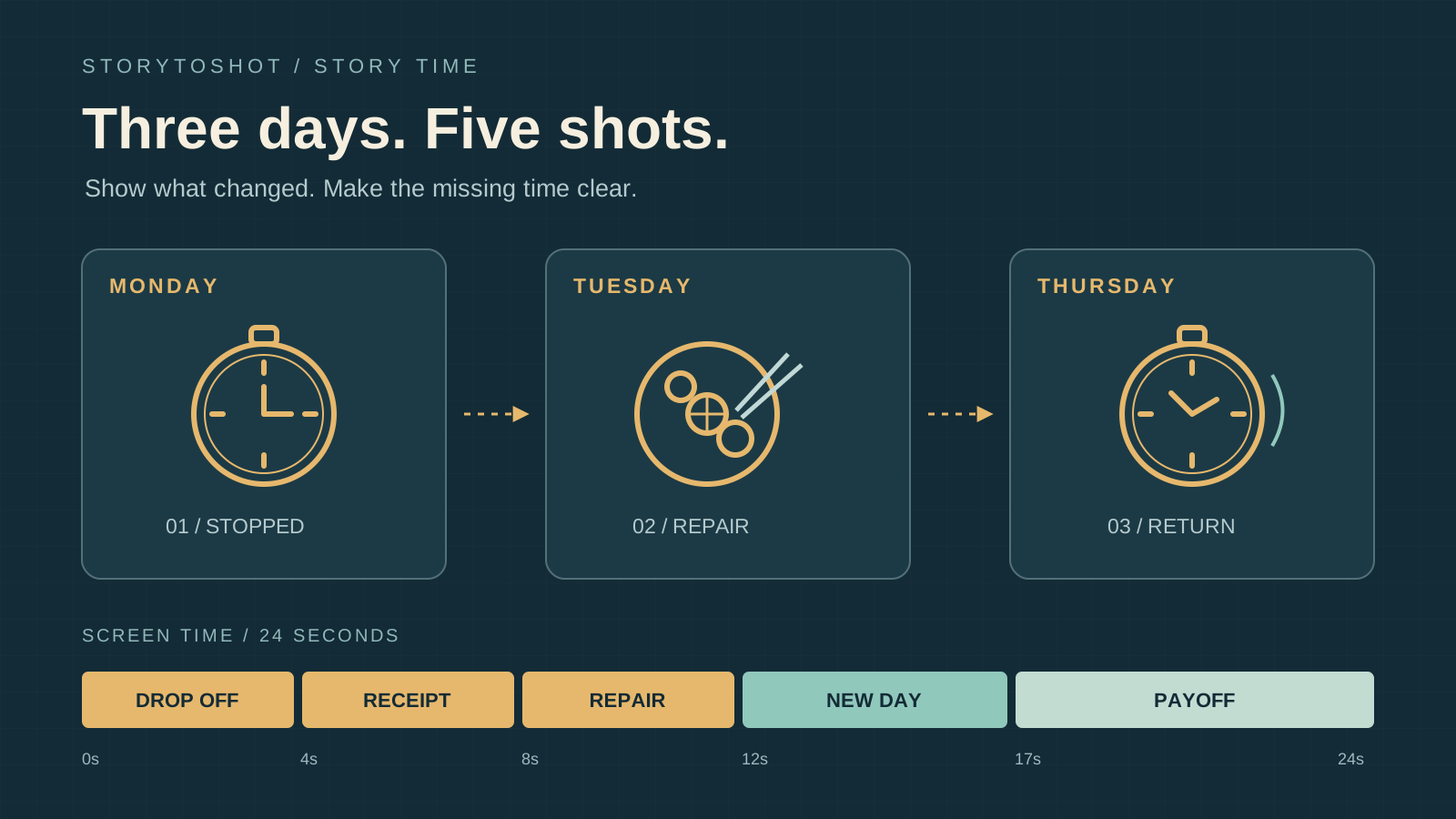
Write two timelines. Story time is Monday drop-off, Tuesday repair and Thursday collection. Screen time is shot one at 0–4 seconds, shot two at 4–8, shot three at 8–12, shot four at 12–17 and shot five at 17–24. Record both when each shot occurs and what new information viewers receive. Shot one establishes the stopped watch and deadline; shot two leaves a receipt; shot three shows that repair work happened; shot four establishes Thursday; shot five proves the repair and resolves the emotion. This exposes where two days disappear and which images merely repeat information. If the sequence is too long, remove repetition before trimming the evidence that makes the time relationship understandable.
3. Pair a time anchor with a changed state
For this example, begin with one explicit time anchor and one visible state change: add “Thursday” in editing when she returns, and show the previously stopped watch running. One establishes when; the other establishes what the wait achieved. A wardrobe change could happen on the same day. Different light could be a stylistic choice. Moving hands prove that a watch runs, not that several days elapsed. Use the smallest set of clues that agree with one another. If the deadline matters, establish it at drop-off with “Can it be ready before his birthday on Thursday?” and connect collection day to that expectation. Create and proofread critical date text separately in editing, instead of depending on incidental lettering in a generated image.
4. Build five shots with a clear landing after each omission
Use this reusable plan. Shot one: a Monday medium shot inside the shop; she puts the stopped watch on the counter and states Thursday’s deadline. Shot two: a close-up of intake; the watchmaker puts the watch and ticket number 17 in a tray as she leaves. Shot three: a Tuesday bench close-up; the same ticket sits beside the open watch while the watchmaker makes one adjustment. Shot four: a Thursday exterior medium shot; she enters again and a date caption appears. Shot five: at the counter, the watchmaker returns the closed watch; moving hands lead into her relieved reaction. Shot three needs evidence of repair, not a complete technical demonstration. Number 17 identifies the item; it is not a date. Distinguish the ticket and date caption so viewers do not confuse them.
5. Put the time jump between shots and the action within them
Do not ask one prompt to cover intake, three days of repair, a reunion and the gift handoff. Define each shot’s starting state, visible action and ending state, then join them on the edit timeline. A brief for shot three could read: “Bench close-up. The open pocket watch sits in the center of the tray, with the numbered ticket at upper left. The watchmaker makes one small adjustment with tweezers, then stops. Locked camera; no customer appears and no watch is returned.” These are production targets to review, not guaranteed outcomes simply because they were written. Give shot four its own arrival action. Keep date captions, subtitles and necessary narration in a separate production record, so changing a date need not require regenerating a performance.
6. Check whether the cut suggests continuity or elapsed time
A hard cut, dissolve or matched composition cannot by itself guarantee “three days later.” Cutting from her reaching out to her receiving the watch encourages a reading of one continuous transaction. End the drop-off action, then establish a new passage through departure, repair and a fresh arrival. A matched tray composition can cut to the repaired watch, but still needs a date or another clue to establish the interval. A dissolve may suit a gentle tone; it is not a unit of time. A sound bridge can connect emotion while also making two periods sound like one continuous event. Make the straight-cut version understandable before adding a transition for rhythm. A more noticeable effect cannot supply missing story information.
7. Test an inexpensive draft with unaided retelling
Assemble five stills, temporary date captions and rough sound into the 24-second draft. Show it once to someone who has not read the script, without announcing that three days pass. Ask how many visits she makes, what happens during the wait, what day the ending occurs and which clues support those answers. Record their words instead of inviting a polite “yes” with “Did you understand?” If they see a repaired watch but cannot place the time, add a time anchor. If they think she stayed in the shop, strengthen departure or arrival. If they recognize the dates but not the reason for waiting, strengthen the repair evidence. This is an ambiguity check, not audience research. After revision, a fresh viewer is more informative than someone who has already heard your explanation.
8. Turn each failure into an actionable revision
Treat three failures separately. Unclear time: keep the footage and first try a longer or better-positioned date caption, checking readability at normal speed. Broken causality: add evidence of repair or waiting; extending an empty establishing shot rarely explains why the watch is fixed. Abrupt emotion: allow her to look, confirm and relax after the handoff, instead of ending as soon as the moving hands appear. Change one main issue per round and record “misreading → revision → new viewing result.” Caption duration and reaction length depend on text and actual viewing, not one number that works for everyone. If extra coverage still fails, revisit whether the deadline and repair meaningfully connect to the character’s goal.
9. State the limits and keep a time-jump review card
This method suits chronological shorts, advertising stories and preproduction previews where viewers should follow time clearly. A mystery can deliberately conceal an interval, and dreams or nonlinear narratives can invite a mistaken reading, but decide when that information will be revealed. Do not explain accidental confusion as style after editing. Repair instruction, evidence presentation and procedural demonstrations also cannot replace required steps with an omission. Keep this review card: “time before; time after; omitted process; retained causal evidence; time anchor; prop state; viewer retelling; pending revision.” When planning in StoryToShot, organize these points in shot descriptions and maintain caption versions in your editing notes. See the story in a low-cost draft before generating the evidence that is actually missing.