1. Compress expression without breaking causality
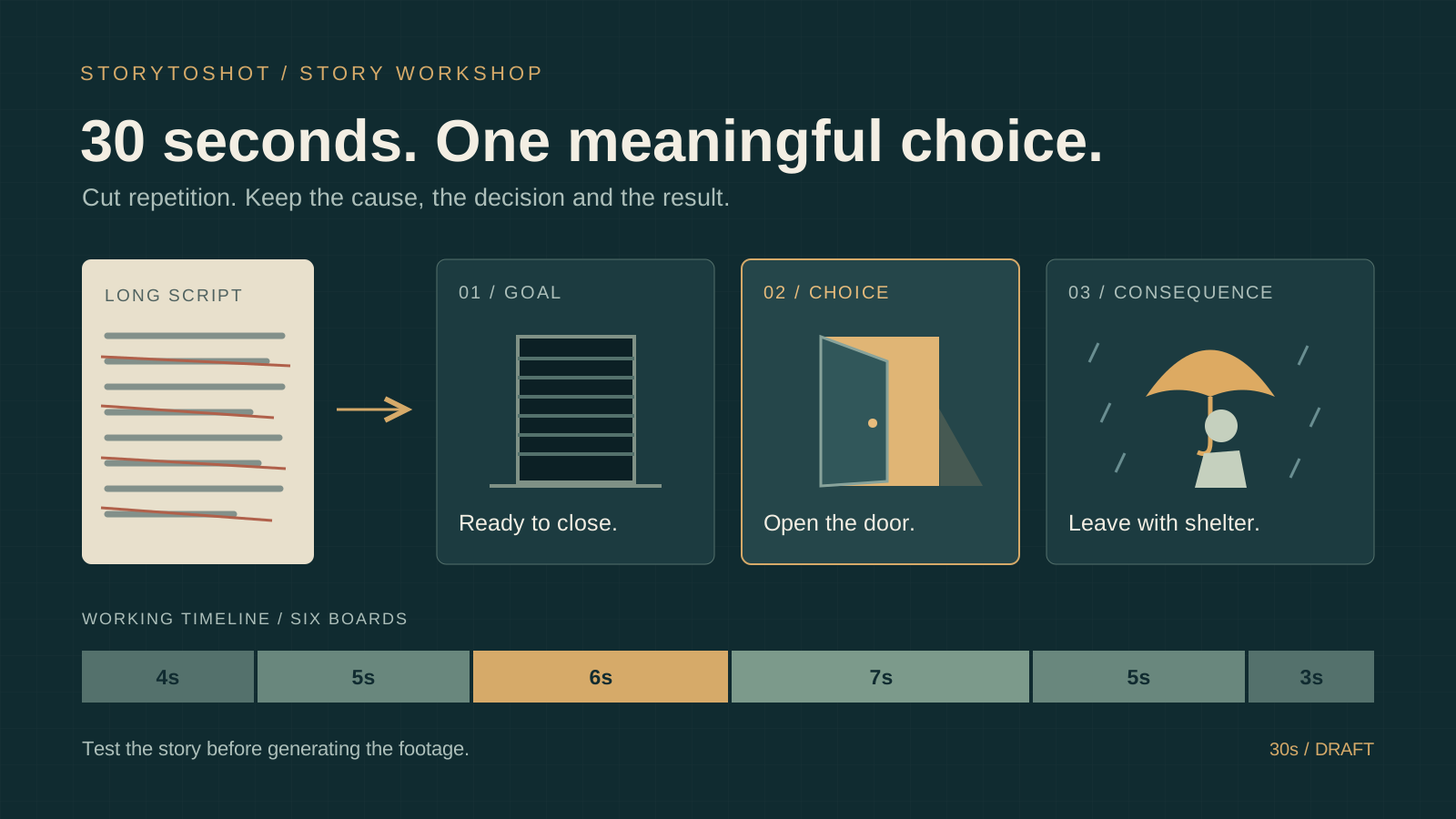
Trying to fit a page of script into thirty seconds often means keeping a little of every event and speeding up the shots. Viewers see plenty happen but cannot explain why anyone acts. First choose the single change this film will tell, then preserve the evidence that causes it. Our fictional example follows an umbrella repairer closing the shop, noticing a child sheltering outside with a broken umbrella, hesitating, reopening and returning the repaired umbrella. The longer script also contains shop history, a rent-demand phone call, a childhood memory and dialogue with a neighbor. The thirty-second version focuses on the change from leaving to staying to help. The other threads step aside. All timings and shot allocations below are working examples, not platform rules or claims that a model can generate the entire story in one attempt.
2. Write a story promise that includes a choice
Write: who wants what, what interrupts them, what they choose and what happens as a result. Here: “The repairer wants to close and go home, notices the child’s broken umbrella, chooses to reopen and enables the child to leave under a working umbrella.” The images must prove that sentence; “a heartwarming story” is insufficient. Mark the changes viewers should understand at the end: the door closes then opens, the umbrella goes from broken to repaired, and the repairer moves from leaving to helping. These changes support one another without narration explaining kindness. If a client requires the rent problem, record it as a hard requirement and reconsider whether thirty seconds can accommodate it. Do not silently remove requirements or hide essential background in unreadable flashes of text.
3. Label the information function of each passage
Break the source script into short statements and label each as goal, obstacle, choice, outcome, background or repetition. Putting tools away and lowering the door curtain both signal closing, so they may be combined. The child in the rain establishes difficulty, but the damaged umbrella must be recognizable or the child may simply seem to be waiting. Reopening proves the choice; the repaired umbrella proves its outcome. Keep both. Shop history that only adds atmosphere can go. A rent call that explains the film’s central moral conflict cannot be removed merely because it is inconvenient to produce. One event may do several jobs, but it still needs enough viewing time. Check the goal–obstacle–choice–outcome chain before counting shots. Attractive cutaways cannot automatically fill an information gap.
4. Delete, combine, then translate into images
First delete threads outside the central change, then combine repeated explanations, then convert necessary abstractions into visible behavior. “He is exhausted but softens” might become: his hand pauses on the latch, he looks at the broken umbrella, releases the latch and opens the door to invite the child inside. A sighing close-up, a childhood flashback and explanatory dialogue are not all needed. Combining also has limits. A shot that must establish closing, discover the child, recognize an old acquaintance, recall the past and repair the umbrella carries too many changes for both comprehension and generation. Organize the sequence around one clear choice. Let clothing, tools and surroundings convey background naturally where possible, but do not expect viewers to decode private symbols that have never been established.
5. Allocate thirty seconds to evidence, not equal shots
Start with six working boards: S01, 0–4 seconds, tools put away and a hand on the latch; S02, 4–9, the child outside with a visibly damaged umbrella; S03, 9–15, the repairer looks at the child, releases the latch and opens the door; S04, 15–22, one clear repair action inside; S05, 22–27, the opened, repaired umbrella is returned; S06, 27–30, the child leaves under it while the repairer stays by the doorway. The choice needs reaction time and the repair needs recognition time, so do not divide the film into six equal five-second shots. The repair sequence uses narrative ellipsis; it does not claim real repairs take seven seconds. If viewers think the umbrella fixes itself, add the necessary action or transition and recover time elsewhere.
6. Use removal tests to find what is essential
Remove each board temporarily and ask three questions: is the reason for the character’s action still clear, is the change between states still clear, and does the ending retain its emotional basis? Without the damaged umbrella, reopening lacks a concrete cause. Without the decision at the door, the repair may look like ordinary business. Without the departure, the story may still work if the handoff clearly establishes that the child has been helped. The final board is therefore a candidate for compression. Being able to guess is not the same as understanding: ask viewers what evidence supports their interpretation. If they rely entirely on assumptions, mark the information as weak. When two boards perform the same job, keep the clearer and more executable one, rather than simply the prettier composition.
7. Watch a rough animatic before generating footage
Place sketches or existing stills on an editing timeline at the provisional durations, add temporary rain and necessary door sounds, and watch at normal speed. Do not use excessive explanation to rescue weak images. Keep scratch dialogue if the intended film depends on it; test without dialogue if that is the design. Ask someone who has not read the script to watch once and retell what the person originally wanted, what changed their mind and what happened. Record missing links, then ask whether the evidence was unseen, too brief or visible but confusing. Adjust composition, duration or causality accordingly instead of calling every problem slow pacing. One viewer can reveal specific doubts but cannot prove universal comprehension. For a defined audience, include additional viewers resembling that audience.
8. Write generation briefs after the compression works
Only after the rough cut works should each board become a generation brief. For S03: “Start: the repairer holds the latch as the door is about to close. Trigger: a look at the damaged umbrella held by the child outside. Action: pause, release the latch, open the door. End: the open doorway and an inviting gesture. Must remain visible: the deliberate change from closing to opening.” Record framing, character references and scene constraints separately; emotional adjectives cannot replace action. If a trial cannot reliably contain these states, split the material into a reaction and a door-opening clip while preserving the single story beat in editing. Six working boards do not require exactly six generated clips or six calls. Track narrative structure, source footage and tool limits separately.
9. Confirm the limits before approving the short version
Save the long script, short script, reasons for cuts and the animatic that passed the retelling exercise. Label the version “the decision to reopen.” Before approval, check that the goal is visible, the trigger explicit, the choice expressed through action and the outcome recognizable. Total duration must include any required opening or closing material. A later request for a brand voiceover, personal history or complete repair procedure requires a new timing allocation, not speeding up the approved thirty seconds. This method suits a short narrative organized around one change. It does not directly suit safety instruction requiring complete steps, intricate mystery reasoning or ensemble stories. Compression changes the emphasis. When necessary information cannot be understood within the duration, narrow the story or extend the film. An explicit tradeoff is better than retaining every event.